
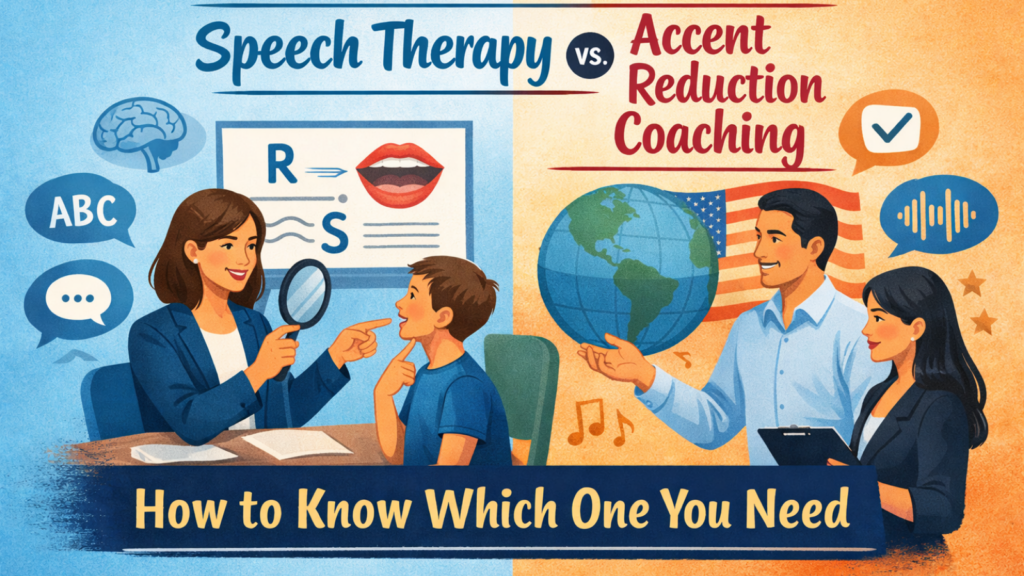
Speech Therapy vs Accent Reduction Coaching: Understanding the Key Differences
If you’ve ever wondered about the difference between speech therapy vs accent reduction coaching, you’re not alone. Many people be unaware what these terms are and who benefits from which one. But they serve very different purposes—and choosing the right one can make all the difference in achieving your communication goals.
What Is Speech Therapy?
Speech therapy is a clinical service provided by a licensed speech-language pathologist (SLP). It focuses on diagnosing and treating communication disorders.
Speech therapy addresses:
-
- Articulation disorders (difficulty producing sounds correctly)
- Phonological disorders (patterns of sound errors)
- Language delays or disorders
- Fluency issues (such as stuttering)
- Voice disorders
- Social communication challenges
- Cognitive-communication disorders (such as strokes)
- Swallowing difficulties
Speech therapy is often medically or educationally necessary and is commonly provided to:
-
- Children with speech or language delays
- Individuals recovering from stroke or brain injury
- People with developmental or neurological conditions
Goal: To improve functional communication when there is a disorder or delay.
What Is Accent Reduction Coaching?
Accent reduction coaching (also called accent modification or pronunciation coach) is a specialized service designed for individuals who already speak English but want to improve clarity, pronunciation, and confidence.
It also helps remove stigma. Having an accent is not a disorder—it’s a natural result of speaking multiple languages. Accent coaching is about choice and empowerment, not correction.
It focuses on:
- Pronunciation of American English sounds
- Intonation and rhythm (prosody)
- Stress patterns in words and sentences
- Commonly mispronounced words
- Listening discrimination and self-monitoring
Accent coaching is ideal for:
-
- Non-native English speakers
- Professionals who want to sound clearer in meetings or presentations
- Individuals who feel misunderstood or not taken seriously due to their accent
- Feel self-conscious about how your speech sounds
Goal: To enhance clarity and confidence—not to eliminate cultural identity or “erase” an accent.
Speech Therapy vs Accent Reduction Coaching: The Core Differences
While there is some overlap in techniques, the intent and population are quite different.
 Key Comparison at a Glance:
|
Feature |
Speech Therapy |
Accent Coaching |
|
Purpose |
Diagnose and treat clinical disorders and delays |
Modify a speech style |
|
Provider |
Licensed SLP |
SLP or Accent Coach |
|
Focus |
Support foundational communication skills including articulation, stutters, learning disabilities, developmental delays, or speech loss after a stroke |
Refine already functional speech, may address vocabulary and grammar, and focus on clarity, confidence and professional communication |
|
Common Clients |
People with speech or language difficulties, stutters, autism, strokes, or delays |
ESL speakers, actors, or professionals |
|
Duration |
Long-term (months/years) |
Short-term (weeks/months) |
Do You Need Speech Therapy or Accent Reduction Coaching?
Here’s a simple way to decide:
You may benefit from speech therapy if:
-
- You struggle to produce certain sounds even in your native language
- Others frequently cannot understand you
- You have a diagnosed speech, language, voice, social-communication, cognitive, fluency, or swallowing disorder
- Your challenges have been present since childhood or after a medical event
You may benefit from accent reduction coaching if:
-
- You speak English fluently but feel misunderstood at times
- You want to sound more natural in American English
- You feel self-conscious about your pronunciation
- You want to improve professional or social communication
Can a Speech-Language Pathologist Do Both?
Yes—and this is where things get interesting.
Some speech-language pathologists (SLPs) are also trained in accent modification, like myself. You want to ensure you get the correct provider to address your needs.
Why This Distinction Matters
Understanding the difference between speech therapy vs accent reduction coaching helps ensure you:
-
- Choose the right service
- Set realistic expectations
- Invest your time and money effectively
Which one do you need?
-
- If you have a diagnosed medical, neurological or learning condition or a physical difficulty speaking, consult a licensed Speech-Language Pathologist for an evaluation.
-
- If you are already a strong communicator but want to reduce misunderstandings or refine your professional presence, look for an accent modification program.
Either way, I as a speech-language pathologist and accent modification coach, I can help you with both. Contact me, Natalie Cohen Speech-Language Pathology for more information or support.
Final Thoughts: Clarity
Whether you need speech therapy or accent reduction coaching, the ultimate goal is the same: clear, confident communication.


