
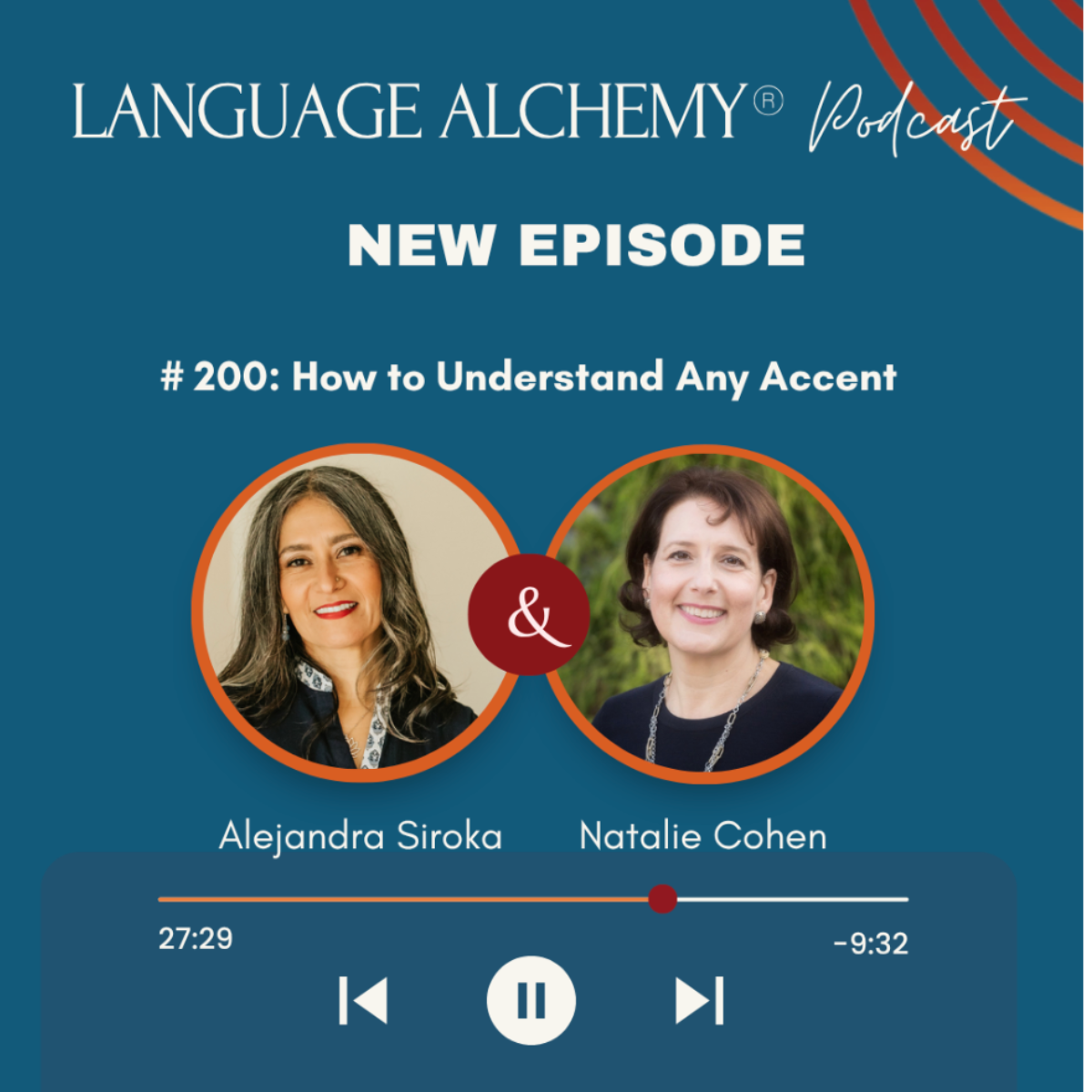
I recently had the pleasure of joining Alejandra Siroka on the Language Alchemy Podcast. We explored why unfamiliar accents can influence first impressions, how unconscious bias affects communication, and why accent modification is about helping people communicate more clearly—not changing who they are.
We also discussed practical strategies that both native and non-native English speakers can use to communicate more effectively with one another.
🎙️ Listen to the Full Conversation
If you’re curious about how accents shape our perceptions and what we can all do to become better communicators, I encourage you to listen to the full episode of the Language Alchemy Podcast before or after reading this article.
Listen here: https://www.languagealchemy.com/podcasts/language-alchemy-podcast/episodes/2149230221
In the meantime, here are five key takeaways from our conversation.
1. Everyone Has an Accent
Whether you were born in the United States or another country, everyone has an accent. There is no such thing as being “accent-free.”
The way we speak reflects many influences, including where we grew up, our cultural background, our social community, and the languages we speak. Accents are shaped by pronunciation, stress, rhythm, intonation, and even nonverbal communication patterns.
When you hear American broadcasters, they often use what is commonly called “Standard American English”. However, this is simply one accent among many American accents—just like Boston, New York, Southern, or Midwestern accents.
When someone speaks English as an additional language, their native language naturally influences their English pronunciation, rhythm, and intonation. Every language has its own sound system, so it is perfectly normal for those patterns to carry over.
There are many stereotypes associated with different accents—both positive and negative. A British “Queen’s English” or “BBC English” accent is often viewed as sophisticated or highly educated, while a strong Boston or New York accent may be unfairly associated with being less educated or more working class. Similar assumptions exist about accents from countries around the world.
The reality is that these stereotypes tell us nothing about a person’s intelligence, education, competence, or character.
Your accent tells the story of your life, your experiences, and your identity. It is something to appreciate—not something to be ashamed of.
2. Our Brains Work Harder With Unfamiliar Speech
Accent bias is rarely intentional. It stems from how our brains process unfamiliar speech.
When we hear an unfamiliar accent, our brains must work harder to decode pronunciation, rhythm, intonation, and sometimes unfamiliar nonverbal communication. Because so much attention is spent understanding individual words, we have fewer mental resources available to focus on the speaker’s ideas.
Researchers call this increased cognitive load, and it can lead listeners to unconsciously judge someone as less intelligent, competent, or professional—even though those judgments have nothing to do with the speaker’s actual abilities.
Research has shown that people with unfamiliar accents may be less likely to be hired, promoted, considered for leadership positions, or even approved for housing.
(https://www.forbes.com/sites/pragyaagarwaleurope/2018/12/30/bias-is-your-accent-holding-you-back/
We also tend to categorize people who sound different from ourselves as belonging to an “out-group.” These unconscious reactions are simply the result of how the brain processes unfamiliar speech—not a reflection of the speaker’s capabilities.
The encouraging news is that our brains adapt remarkably well. The more exposure we have to different accents, the easier they become to understand.
3. Accent Modification Isn’t About Erasing Identity
One of the biggest misconceptions about accent modification is that it tries to eliminate a person’s accent.
This is a myth.
Accent modification—sometimes called pronunciation training or accent reduction—is about helping people communicate more clearly, confidently, and effectively while preserving their identity.
The goal isn’t to sound like someone else. It’s to improve intelligibility by working on pronunciation, stress, rhythm, and intonation so listeners can focus on the speaker’s message instead of struggling to understand the speech.
Many people seek accent modification because they want to participate more confidently in meetings, interviews, presentations, or everyday conversations—not because they want to erase their cultural background.
To find out more about accent modication: https://nataliecohenslp.com/accent-reduction-coaching-what-it-is-and-how-it-works/
Related blogs on pronunciation, vowels, rhythm, intonation, or word stress:
- https://nataliecohenslp.com/mastering-american-vowels/ https://nataliecohenslp.com/american-english-pronunciation-non-phonetic-words-you-must-know/
4. Communication Is a Shared Responsibility
One of the most important messages from the podcast is that communication is a two-way street.
Non-native English speakers can learn pronunciation, rhythm, stress, and intonation patterns that improve clarity. At the same time, native English speakers can become better listeners by increasing their exposure to different accents and learning about communication styles from other cultures.
For example, cultural differences in greetings, eye contact, directness, conversational pacing, personal space, and body language can all influence how messages are interpreted.
When both speakers and listeners make small adjustments, communication becomes easier—and more respectful—for everyone.
Exposure Changes Perception
One of the encouraging findings from research is that our brains adapt remarkably quickly. The more often we hear a particular accent, the easier it becomes to understand. What initially feels unfamiliar soon becomes effortless.
This is one reason diverse workplaces, international teams, and multicultural communities often experience fewer communication challenges over time—they’ve trained their ears through regular exposure.
Learning about another person’s communication style is just as valuable as learning about their language.
5. Confidence Changes Everything
During the podcast, I shared the story of a physician I worked with.
After moving to the United States, she was told by a supervisor that she was difficult to understand during presentations. Although she was highly skilled in her profession, that single comment affected her confidence so deeply that she stopped speaking English outside of work whenever possible.
Unfortunately, stories like hers are not uncommon.
Many of my clients tell me they avoid speaking in meetings, rehearse conversations ahead of time, or stay quiet in social situations because they worry about being judged for the way they speak. I’ve also worked with people who grew up in the United States with strong regional accents who have experienced similar feelings.
Confidence often has a greater impact on communication than pronunciation itself. When people feel accepted and understood, they communicate more naturally, clearly, and effectively.
https://nataliecohenslp.com/mastering-presentations-inspire-confidence/
Moving Forward Together
We all carry unconscious assumptions about the way people speak. The first step toward reducing accent bias is recognizing that those assumptions exist.
Accents are not signs of intelligence, education, competence, or professionalism. They reflect our experiences, cultures, and identities.
Rather than expecting everyone to sound the same, we can become better communicators by listening with curiosity, giving people time to express themselves, and focusing on the value of their ideas instead of the way they sound.
When speakers work toward greater clarity and listeners work toward greater understanding, everyone benefits.
That’s how we build confidence, create meaningful connections, and foster more inclusive communication.
Want to Learn More?
If you’d like to explore these ideas in more depth, I invite you to listen to my conversation with Alejandra Siroka on the Language Alchemy Podcast. Together we discuss:
- Why unfamiliar accents influence first impressions
- The science behind accent bias and cognitive load
- Why accent modification is about improving clarity—not changing your identity
- Practical communication strategies for both native and non-native English speakers
- How confidence and communication go hand in hand
 Listen to the full episode here:
https://www.languagealchemy.com/podcasts/language-alchemy-podcast/episodes/2149230221
If you’re interested in improving your American English pronunciation, speaking with greater confidence, or learning more about accent modification, I’d love to help.
Contact me for a free consultation


