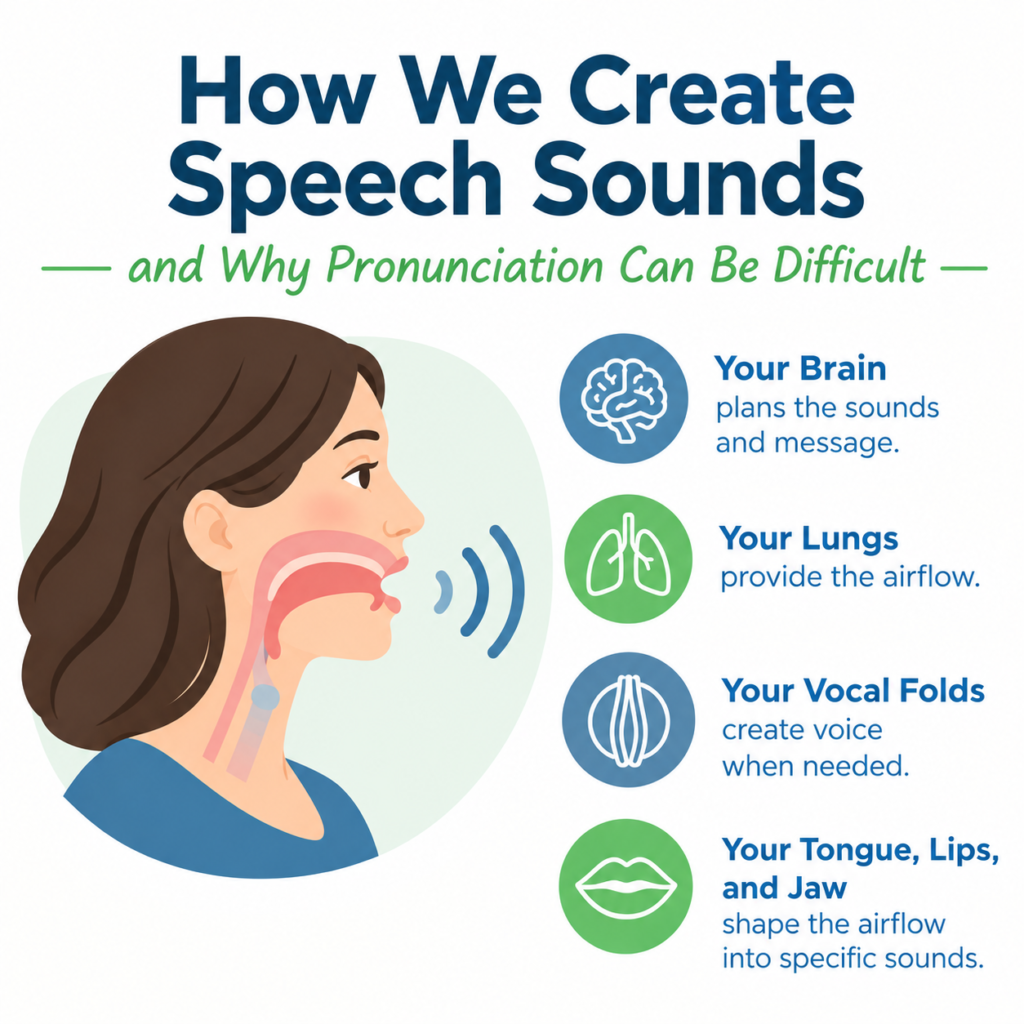
Speech sound production is complex, involving the brain, breathing, vocal folds, tongue, lips, jaw, and other parts of the mouth. When pronunciation is difficult, the reason may be an articulation difficulty, a neurological speech disorder, or the influence of a person’s native language.
We often think of speaking as something that simply happens. We have an idea, open our mouths, and words come out. But producing even a simple word requires many systems in our body to work together quickly and precisely.
Understanding how speech sounds are made can help explain why some sounds are difficult—and why the right approach to improving speech depends on why the difficulty is occurring.
How Do We Create Speech Sounds?
Speech begins in the brain.
Before you say a word, your brain has to decide what you want to communicate and plan the sounds and movements needed to produce it. That information is then translated into coordinated movements involving your breath, voice, tongue, lips, jaw, and other structures.
Here is a simplified version of what happens:
- Your brain plans the message and speech sounds.
Your brain determines which sounds need to be produced and the order in which they should occur.
- You breathe.
Air from your lungs provides the airflow needed for speech.
- Your vocal folds create voice when needed.
Air passes through the larynx, where the vocal folds to vibrate to create a voiced sound (e.g., /b/, /d/, /l/). Other sounds, such as /s/ or /f/, are produced without vocal-fold vibration.
- Your mouth shapes the airflow.
Your tongue, lips, teeth, and jaw move into very specific positions to create different sounds.
- Your brain coordinates everything.
The timing has to be precise. The movements for one sound often overlap with the movements for the sounds before and after it. This is one reason speaking naturally requires so much coordination.
The American Speech-Language-Hearing Association (ASHA) describes articulation as involving the appropriate timing, direction, force, speed, and placement of the speech structures.
Your Tongue, Lips, and Jaw All Have a Job
Different speech sounds require different combinations of movements.
For example, the /p/ sound is produced by bringing the lips together and then releasing them. The /t/ sound involves placing the tongue near the alveolar ridge—the area just behind the upper teeth.
The /s/ sound requires a narrow channel of airflow created by the tongue, while the /r/ sound requires a very different tongue configuration.
Changing how open or closed your jaw is important to the production of vowels. Your jaw is wider open for short /o/ (bought) vs. long /o/ (boat).
Even small changes in tongue, lip, and jaw position can change the sound we hear.
If you’d like to see what this looks like for a specific sound, check out my guides on how to produce the S sound, how to produce the R sound, how to pronounce TH sound, and V and W pronunciation.
Why Do Some People Have Trouble Pronouncing Sounds?
There isn’t one reason that someone may have difficulty with pronunciation. In fact, it is important to understand the difference between several types of speech sound difficulties.
1. Articulation Difficulties
An articulation difficulty occurs when someone has trouble physically producing a particular speech sound accurately.
For example, a child might have difficulty producing:
- R in “rabbit”
- S in “sun”
- TH in “thumb”
- L in “lion”
A person might substitute one sound for another, leave a sound out, or produce a distorted version of the sound.
For children, some speech sound errors are part of typical development and resolve as they mature. Other difficulties persist and may benefit from speech therapy. ASHA describes speech sound disorders as difficulties involving the perception, motor production, or phonological representation of speech sounds.
In articulation therapy, an SLP helps a child learn what the sound should feel and sound like, establish the correct tongue or mouth position, and gradually practice the sound in increasingly complex situations—from a single sound to words, sentences, and eventually conversation.
You can learn more about Speech & Articulation Therapy in Lexington, MA.
2. Neurological Speech Difficulties
Sometimes difficulty producing speech sounds isn’t primarily about knowing where to put the tongue or lips. The underlying challenge may involve the brain’s ability to plan, program, coordinate, or control the movements needed for speech.
Two examples are apraxia of speech and dysarthria.
Apraxia of Speech
Apraxia of speech is a neurological speech disorder involving difficulty planning or programming the movements needed for speech. A person may know exactly what they want to say but have trouble coordinating the precise movements needed to say it.
Speech may include:
- Inconsistent sound errors
- Difficulty sequencing sounds
- Attempts to correct or restart words
- Difficulty with longer or more complicated words
- Visible effort or “groping” for the correct mouth position
Dysarthria
Dysarthria is another type of neurological speech disorder. It occurs when neurological damage or disease affects the muscles and motor systems involved in speech.
Depending on the underlying condition, a person may experience changes in:
- Speech clarity
- Speech rate
- Loudness
- Voice quality
- Tongue, lip, or jaw movement
- Coordination
- Intonation
ASHA notes that dysarthria can result from neurological injury, disease, or disorder and may affect the strength, speed, range, steadiness, tone, or accuracy of speech movements.
This is why someone who suddenly develops difficulty speaking clearly—particularly following a neurological event or with a progressive neurological condition—may need a comprehensive speech-language evaluation rather than simply practicing individual sounds.
3. Pronunciation Difficulties When Learning Another Language
There is another important reason someone may have difficulty pronouncing a sound: that sound may not exist in their native language.
This is very different from having a speech disorder.
Every language has its own sound system. If a person grows up speaking a language that does not contain a particular sound, their brain and speech system may not have had years of practice producing it.
For example, the English TH sounds in think and this can be challenging for some people learning American English because these sounds may not occur in their first language.
Similarly, the American English R, W, V, or certain vowel sounds can be challenging depending on a person’s native language.
Not all languages share the same speech sounds or the same rules for combining sounds. When someone speaks more than one language, the sound system of one language can influence the production of another. This is called language transfer and does not, by itself, indicate a speech disorder.
You can read more about why adults may struggle with pronunciation when learning a new language.
Speech Disorder or Accent?
This is an important distinction.
A person who speaks English with an accent is does not have a speech disorder.
An accent reflects the influence of a person’s language background, region, community, or other linguistic experiences. Everyone has an accent—including people who speak what is commonly called “standard” American English.
For someone learning American English as an additional language, certain pronunciation patterns may simply reflect the sound system of their first language.
ASHA recommends considering a person’s entire linguistic background when determining whether a speech difference represents a communication disorder or is consistent with second-language acquisition.
That’s why an SLP or accent modification professional shouldn’t simply listen for sounds that are “different” and assume they are incorrect. The first step is understanding why the sound is being produced that way.
Why the Difference Matters
Consider three people who all have difficulty producing the /R/ sound.
They might sound similar to a listener, but the reason could be completely different:
Child with an articulation difficulty:
The child may have difficulty learning the correct tongue position and coordinating the movement needed for /R/.
Child or an adult with a neurological disorder:
The person’s difficulty may result from changes in motor planning or control following a neurological condition.
Adult learning American English:
The person may be using a version of /R/ influenced by the sound system of their native language.
The same speech sound can therefore require very different approaches to assessment and treatment.
How Speech Therapy Can Help
A speech-language pathologist begins by determining what is contributing to the difficulty.
Depending on the person, this may involve looking at:
- Which sounds are difficult
- Whether the difficulty occurs consistently
- Tongue, lip, and jaw positioning
- Speech motor coordination
- Ability to hear and distinguish sounds
- The person’s language background
- The effect of the difficulty on intelligibility
- Other speech, language, cognitive, or neurological factors
Treatment is then individualized.
For a child with an articulation difficulty, therapy may focus on learning the correct placement and practicing the sound in increasingly complex contexts.
For someone with a neurological speech disorder, treatment may focus on motor planning, coordination, speech rate, precision, or strategies for improving intelligibility.
For a non-native English speaker, accent modification may focus on the specific American English sounds, stress patterns, rhythm, and intonation patterns that are affecting intelligibility.
The Goal Isn’t Always to “Sound Different”
For children receiving articulation therapy, the goal is generally to help them produce developmentally appropriate speech sounds clearly.
For someone with a neurological speech disorder, the goal may be to improve intelligibility and make communication easier.
For a non-native English speaker, the goal of accent modification doesn’t have to be eliminating an accent. Instead, it can be about having more choices in how you communicate and making it easier for others to understand you.
My approach to accent modification is focused on helping non-native American English speakers communicate more clearly and confidently while maintaining their cultural and linguistic identity. You can learn more about Accent Reduction Training and how individualized pronunciation coaching works.
When Should You Consider an Evaluation?
Consider talking with a speech-language pathologist if:
- A child is significantly harder to understand than peers of the same age.
- A child continues to have difficulty with sounds that should have developed by their age.
- An adult experiences a new or worsening change in speech.
- Speech becomes less clear following a stroke, brain injury, or other neurological condition.
- You know what you want to say but suddenly have difficulty getting the sounds out.
- You speak English as an additional language and certain sounds consistently affect how easily others understand you.
- You aren’t sure whether a pronunciation difference is an accent or a speech disorder.
A professional evaluation can help determine what is actually causing the difficulty, which is the first step toward choosing the right approach.
Speech Is a Remarkably Complex Skill
The next time you say a word, consider how much is happening in a fraction of a second. Your brain plans the sounds, your lungs provide airflow, your vocal folds create voice when needed, and your tongue, lips, jaw, and other structures move into precise positions—all while coordinating with the sounds that come before and after.
So when someone has difficulty with a speech sound, there is usually much more going on than simply “saying the sound wrong.”
Whether the challenge comes from an articulation difficulty, a neurological condition, or learning the sound system of another language, understanding the reason behind the difficulty makes it possible to provide more targeted and effective support.
If you have questions about your or your child’s speech, pronunciation, or communication, contact me to learn more about speech therapy and accent modification services in Lexington, MA and beyond.
Helpful Resources