
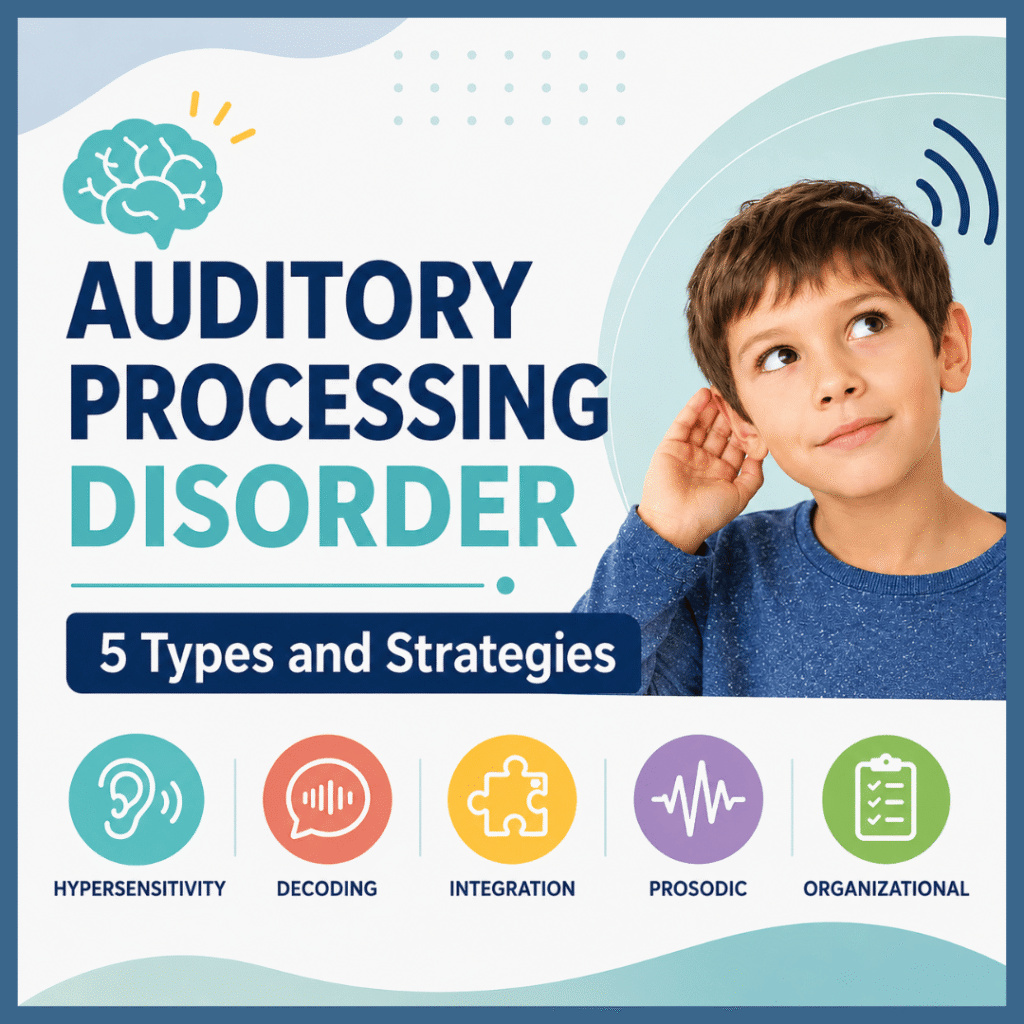
Auditory processing disorder (APD) is not just one condition. It can affect different listening skills and look very different from one person to another.
Someone with APD may hear sounds normally but have trouble making sense of what they hear. They might struggle to understand speech in a noisy room, tell similar sounds apart, remember spoken information, follow a series of directions, or understand someone’s tone of voice.
Knowing which auditory processing skills are difficult can help identify strategies that make listening and learning easier.
What Is Auditory Processing Disorder?
Auditory processing disorder, also called central auditory processing disorder (CAPD), occurs when the brain has difficulty processing and interpreting auditory information.
Hearing isn’t simply detecting sound. The brain must organize and interpret the information coming from the ears. This includes distinguishing sounds, focusing on a speaker when there is background noise, remembering what was said, and recognizing the order and patterns of sounds.
With APD, a person may hear the words but have difficulty processing them efficiently.
APD can occur in both children and adults. It may be associated with factors such as aging, head injury, neurological conditions, premature birth, or a history of recurrent ear infections.
For more information about APD, see the Cleveland Clinic’s overview of auditory processing disorder.
APD Is Different From Hearing Loss
APD is not the same as traditional hearing loss. A person can have normal hearing sensitivity but still have difficulty processing or understanding auditory information.
APD can also occur alongside other conditions, including ADHD, autism, language disorders, or learning difficulties. These conditions are not the same as APD, but some of their symptoms can overlap.
A comprehensive evaluation can help determine what is contributing to a person’s listening difficulties.
The American Speech-Language-Hearing Association (ASHA) provides additional information about central auditory processing disorder, including assessment and intervention.
APD Can Affect Different Listening Skills
There isn’t one APD profile that fits everyone. Difficulties may involve:
- Auditory discrimination: telling different sounds apart
- Auditory figure-ground: focusing on speech when there is background noise
- Auditory memory: remembering information that was heard
- Auditory sequencing: remembering information in the correct order
- Sound localization: determining where a sound is coming from
- Temporal processing: recognizing timing, rhythm, and patterns in sound
These skills can be affected individually or in combination.
5 Ways Auditory Processing Disorder Can Present
APD is complex, and professionals may describe auditory processing difficulties in different ways. The following five categories provide a helpful way to understand some of the ways APD may affect listening.
1. Hypersensitivity: “The Sounds Are Too Much”
Some people become overwhelmed by sounds or have difficulty filtering out competing noises. A busy classroom, restaurant, or other noisy environment can make listening especially challenging.
You might notice:
- Difficulty understanding speech in noisy places
- Becoming overwhelmed when several people are talking
- Sensitivity to certain sounds
- Needing quiet to concentrate or study
- Becoming distracted by background noise
- Missing parts of multi-step directions
Strategies
- Reduce unnecessary background noise.
- Choose quieter environments when possible.
- Seat the child close to the teacher or speaker.
- Turn off competing sounds such as television or music.
- Provide written or visual information in addition to spoken directions.
- Allow quiet breaks after periods of intense listening.
2. Decoding: “I Hear It, But I Can’t Make Out the Words”
Decoding difficulties involve processing the individual sounds that make up spoken words. Someone may hear speech but have trouble distinguishing sounds or understanding words quickly.
You might notice:
- Confusing similar-sounding words
- Frequently saying “What?” or “Huh?”
- Difficulty understanding fast speech
- Trouble understanding television or movies
- Difficulty with spelling or sound-based reading tasks
- Problems distinguishing individual speech sounds
Strategies
- Slow down the speaker’s rate of speech.
- Emphasize important words.
- Repeat or rephrase information when needed.
- Pair spoken information with written words or pictures.
- Reduce background noise.
- Practice distinguishing similar speech sounds when appropriate.
3. Integration: “I Can’t Listen and Do Something Else”
Integration difficulties can make it challenging to process auditory information while doing another task.
For example, a student may understand what a teacher says but struggle to listen, take notes, and look at the board at the same time.
You might notice:
- Difficulty taking notes while listening
- Trouble connecting spoken and written information
- Slow responses to questions
- Difficulty listening while completing another task
- Mental fatigue after extended listening
Strategies
- Provide notes or written directions.
- Present information both verbally and visually.
- Break complex tasks into smaller steps.
- Give extra time to process questions.
- Preview important vocabulary or concepts.
- Check understanding rather than simply asking, “Do you understand?”
4. Prosodic: “I Don’t Always Know What Your Tone Means”
Prosodic processing involves understanding the meaning communicated through pitch, rhythm, stress, and intonation.
These features can tell us whether someone is joking, annoyed, excited, asking a question, or being sarcastic.
You might notice:
- Difficulty recognizing sarcasm
- Trouble understanding emotional tone
- Misinterpreting jokes or indirect language
- Difficulty understanding changes in pitch or intonation
- Difficulty recognizing how someone is feeling from their voice
- A relatively monotone speaking style
Strategies
- Make the speaker’s intended meaning more explicit.
- Practice identifying different emotions from tone of voice.
- Use role-playing and video examples.
- Practice saying the same sentence with different emotions.
- Teach sarcasm, humor, and figurative language directly.
- Pair tone of voice with facial expressions and other visual cues.
5. Organizational: “I Have Trouble Keeping It All in Order”
Organizational difficulties can affect the ability to remember and arrange auditory information in the correct sequence.
A child may understand each part of a direction but lose track when several steps are given at once.
You might notice:
- Forgetting spoken instructions
- Difficulty following multi-step directions
- Mixing up the order of information
- Forgetting details from conversations or lessons
- Difficulty organizing verbal responses
- Becoming confused when given too much information at once
Strategies
- Give directions one or two steps at a time.
- Number the steps.
- Use written checklists and visual schedules.
- Have the child repeat directions in their own words.
- Use memory strategies such as visualization and grouping.
- Provide important information before it is needed.
Strategies That Can Help With Many Types of APD
While strategies should be tailored to the individual’s needs, several approaches can make listening easier.
Reduce background noise
A quieter environment makes it easier to focus on the speaker and process what is being said.
Use visual supports
Written directions, pictures, diagrams, notes, and demonstrations give the brain another way to access information.
Break information into smaller pieces
Shorter chunks of information are often easier to process and remember than a long explanation.
Allow processing time
Give the person a few extra seconds to think before expecting an answer. A delayed response doesn’t necessarily mean they don’t know the answer.
Encourage self-advocacy
Children can learn to recognize when listening is difficult and ask for what they need:
- “Can you say that more slowly?”
- “Can you write that down?”
- “Can you give me one direction at a time?”
- “Can we go somewhere quieter?”
These skills help children become more independent listeners.
APD Does Not Affect Intelligence
Auditory processing difficulties have nothing to do with intelligence.
A child may struggle to remember a teacher’s verbal instructions but understand the material very well when it is written down. Another child may have difficulty following a conversation in a noisy classroom but have no trouble understanding the same conversation in a quiet setting.
The difficulty is with processing auditory information—not with how intelligent a person is.
This is especially important for children because listening difficulties can sometimes be mistaken for inattention, lack of effort, or poor comprehension.
What Should You Do If You Suspect APD?
If your child consistently struggles to understand spoken information, particularly when their hearing appears normal, talk with your child’s pediatrician, audiologist, or speech-language pathologist.
An audiologist can evaluate hearing and, when appropriate, auditory processing skills. A speech-language pathologist can evaluate speech and language skills and help determine whether language difficulties may also be affecting listening and learning.
Because APD can look similar to other communication, attention, or learning difficulties, identifying the underlying problem is an important first step.
The American Speech-Language-Hearing Association (ASHA) provides information about the evaluation and management of central auditory processing disorder.
The Bottom Line
Auditory processing disorder doesn’t look the same for everyone.
One child may struggle to distinguish sounds. Another may become overwhelmed by background noise. Someone else may have difficulty remembering directions, organizing information, or understanding tone and sarcasm.
The key is to identify the specific listening skills that are difficult and provide strategies that address those needs.
With the right support, children with auditory processing difficulties can become more successful and confident listeners.
How Speech and Language Therapy Can Help
If auditory processing difficulties are affecting your child’s ability to understand language, follow directions, participate in the classroom, or communicate with others, a speech and language evaluation can help identify areas that may be contributing to the problem.
At Natalie Cohen Speech Language Therapy, individualized therapy can help children strengthen communication skills and develop strategies for managing listening and language challenges.
If you’re concerned about your child’s ability to process spoken information, contact us to learn more about treatment.


